Women’s Wealth Building Initiative · Rhode Island
Put wealth in women’s hands—before crisis.
Rhode Island can begin building protected private capital at birth, giving the next generation a path to homes, businesses, education, and genuine independence.
“Income pays today’s bills. Property changes tomorrow’s choices.”

Change the starting point
Stop managing poverty after it happens. Build ownership first.
Government spends heavily after families are already under pressure: rent assistance, food assistance, childcare, medical care, emergency aid, and other crisis programs. This proposal tests a different approach.
Every eligible Rhode Island child would receive a protected Childhood Capital Account. The money would be invested over eighteen years and reserved for approved wealth-building purposes.
A woman who owns assets in her own name has reserves, bargaining power, and choices.
Why ownership matters
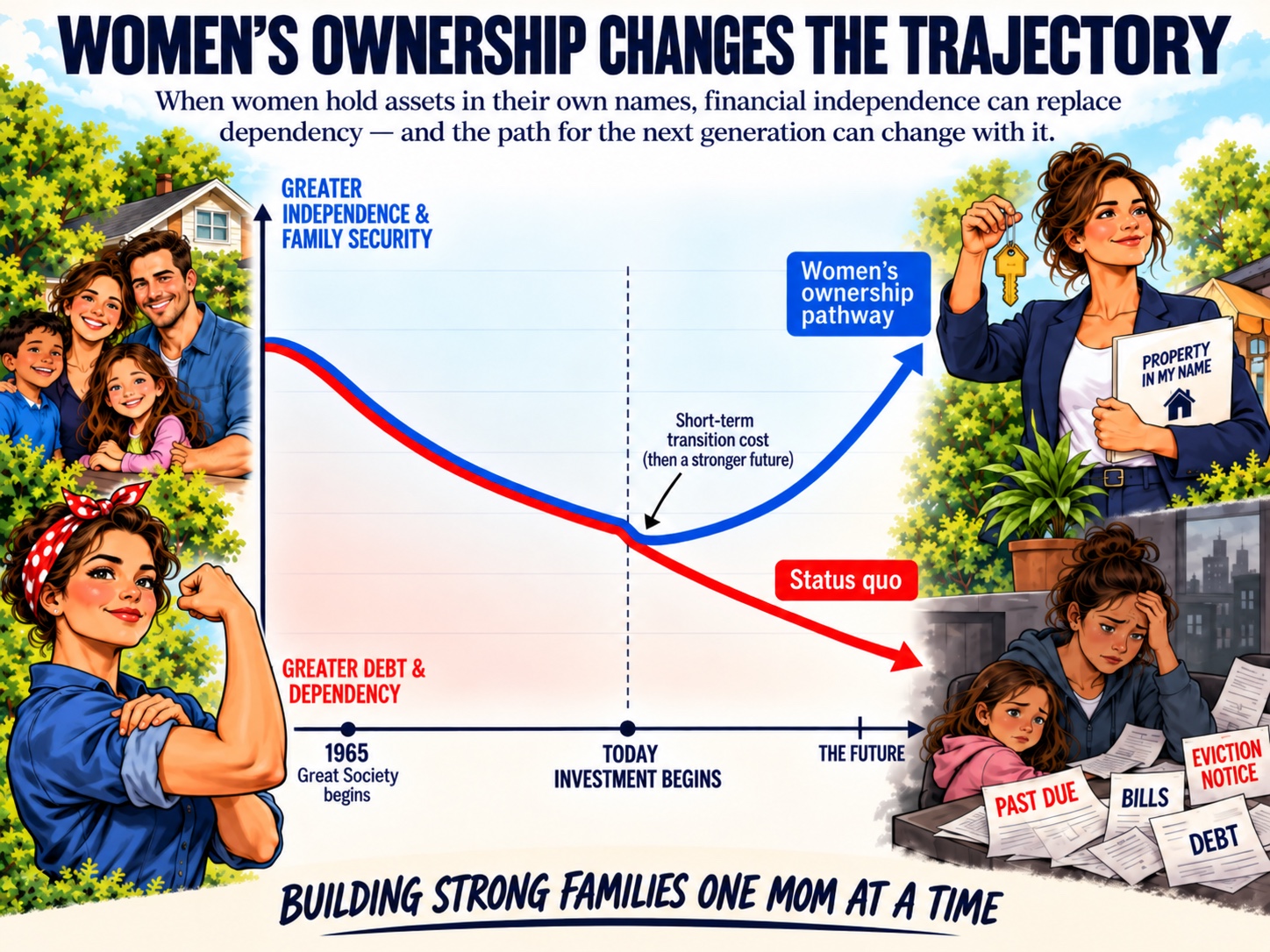
The policy changes the direction, not just the payment.
The blue path shows the proposal’s purpose: accept a transition cost now so women can hold assets, build security, and change what is possible for the next generation. The red path shows the cost of continuing to manage hardship only after it arrives.
Let compounding do its work
What eighteen years can build.
The model uses weekly deposits of $100—the equivalent of $5,200 a year—for 936 weeks. Move the rate to see how the same deposits change under different illustrative returns.
This calculator uses a nominal annual rate divided by 52 and deposits at the end of each week. Investment returns are not guaranteed.
0%3%6%9%
Modeled account at age 18
$187,381
Deposits$93,600
Modeled growth$93,781
Illustration: $100 weekly × 936 weeks. The 7% setting matches the fiscal workbook’s household-wealth example.
How the proposal works
Protected capital with a purpose.
The account is an investment trust, not ordinary spending money. Legislation would define eligibility, administration, permitted uses, and safeguards.
- 01
Open an account at birth
Every eligible child receives an individually tracked Childhood Capital Account.
- 02
Use a sliding public contribution
The state fully funds up to $5,200 annually for family income through $40,000, then phases its share to zero at $200,000.
- 03
Invest for eighteen years
Family, employer, private, philanthropic, federal, and public sources may all contribute under the model.
- 04
Protect the principal
Withdrawals are limited to approved uses that create security, skills, property, or lasting earning capacity.
The central policy choice
Women own their accounts—and the choices those assets make possible.
A woman keeps her Childhood Capital Account whether or not she becomes a mother. Approved uses could include:
- Buying a home
- Starting a business
- Education or occupational training
- Transportation needed for work
- Qualifying health needs
- Support during early motherhood
- Retirement
Responsibility at fatherhood
The man’s account follows a different rule.
If he never fathers a child, his account remains invested for retirement. When he fathers his first child, the full account balance transfers to the mother when she gives birth.
The transfer belongs to the mother. It is distinct from child support and recognizes the physical burden of pregnancy, childbirth, and recovery.
His protected account→Birth of first child→Property in her name
Rhode Island already has a starting point
The Baby Bond Trust establishes the basic machinery.
Rhode Island enacted the Baby Bond Trust in 2025. Once fully funded, it provides a one-time $3,000 trust allocation for qualifying children whose families receive RI Works during the child’s first year. The Treasurer would invest the funds for approved wealth-building uses.
The Women’s Wealth Building Initiative is much larger: annual deposits for eighteen years, broader funding, and a deliberate focus on property controlled by women.
The complete fiscal workbook
Five scenarios. A 150-year test.
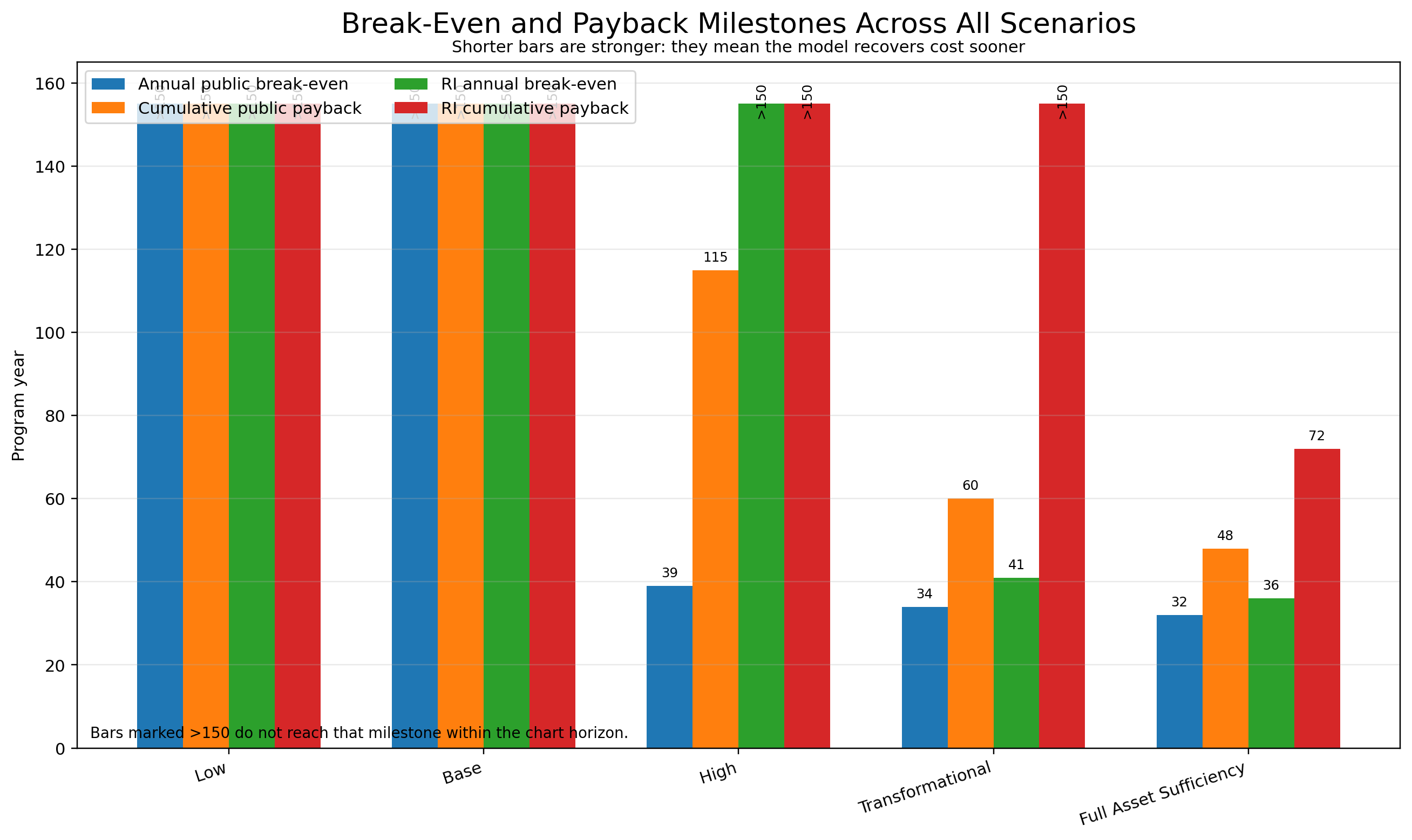
The model compares Low, Base, High, Transformational, and Full Asset Sufficiency assumptions. It measures when annual savings exceed annual cost and when accumulated gains repay earlier public investment.
Download the full Excel model| Scenario | Annual public break-even | Cumulative public payback | Annual RI break-even* | Cumulative RI payback* |
|---|---|---|---|---|
| Low | >150 | >150 | >150 | >150 |
| Base | >150 | >150 | >150 | >150 |
| High | 39 | 115 | >150 | >150 |
| Transformational | 34 | 60 | 41 | >150 |
| Full Asset Sufficiency | 32 | 48 | 36 | 72 |
*The Rhode Island columns assume the state receives 50% of modeled federal savings. That arrangement is an assumption, not current law. All results are scenarios, not forecasts.
Work still required before enactment
Turn a bold policy into a lawful one.
The proposal’s different rules for men’s and women’s accounts require serious constitutional analysis. The financing assumptions, trust governance, investment standards, paternity determination, property transfer, and interaction with federal benefit rules also require legislation and expert review.
An Attorney General cannot create this program alone. Alan would convene the legal and fiscal work, publish the analysis, protect the trust structure, and help lawmakers draft a defensible proposal.
Read the current federal standard for sex-based classifications ↗Read the work behind the page
The complete proposal, summary, workbook, and supporting graphic.
The webpage is a guide. These files contain the full argument, assumptions, scenario calculations, FAQs, and source notes.
7-page PDFPut the Wealth in Women’s HandsFull essay and twenty questions answered
One-page DOCXPolicy SummaryCore design, figures, milestones, and cautions
Excel workbookComplete Fiscal ModelAll scenarios, assumptions, calculations, and graphs
Full-size graphicOwnership Changes the TrajectoryThe initiative’s two possible paths in one illustration
Build ownership that lasts
Women’s ownership changes the trajectory.
Give a woman property in her own name, and she gains more than a monthly benefit. She gains a foundation she can build on—and pass forward.